.avif)
.avif)
DNA vs RNA Aptamers: A Practical Guide to Stability, Binding, and Use Cases

Introduction
In the fast‑moving world of molecular tools, think of aptamers as tiny “keys” made from single strands of DNA or RNA, each folded to fit one specific “lock” such as a virus spike protein, a cancer marker, or a trace toxin. These keys open doors that antibodies cannot reach, yet they bring their own strengths: DNA keys are tough and long‑lasting, while RNA keys are nimble and can twist into more intricate shapes.
This article keeps the focus simple: When should you choose a DNA aptamer and when is RNA the better fit? We will compare their stability, binding affinity, and real‑world uses, giving you a clear checklist rather than a dense theory. By the end, you will know which scaffold best suits your diagnostic sensor, therapeutic conjugate field test or application specified later, and why a few clever chemical tweaks can tip the balance either way.
Structural & Chemical Stability
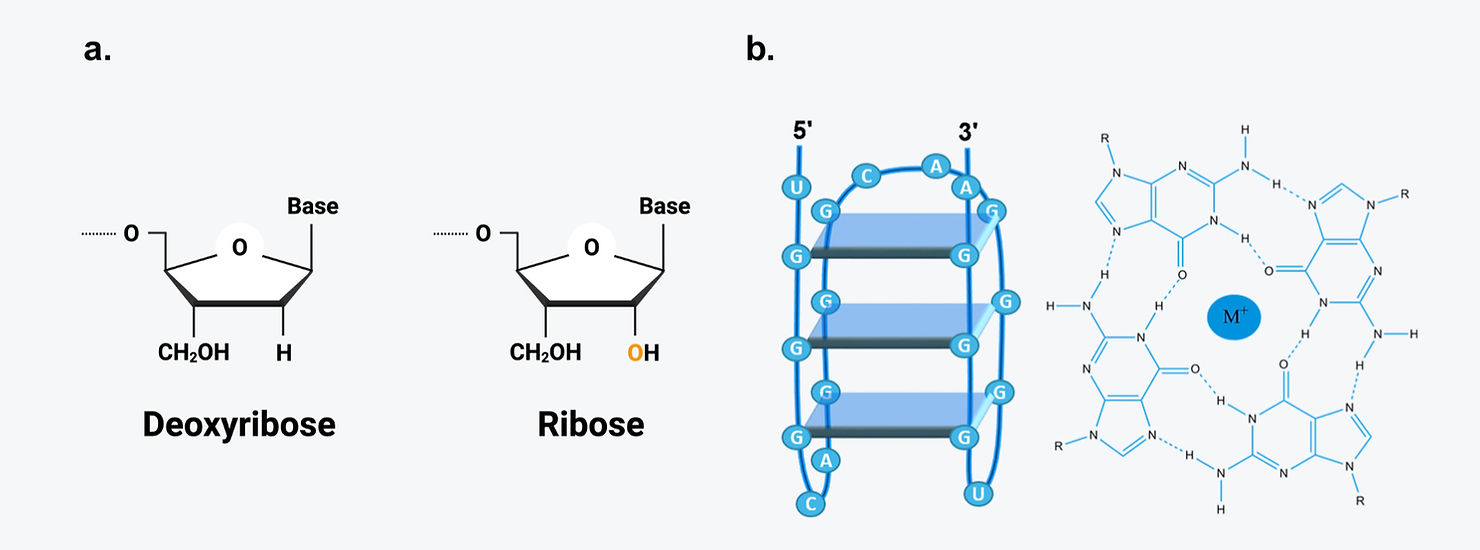
At the molecular level, the critical difference between DNA and RNA lies in a single atom: RNA’s ribose (compared to deoxyribose in DNA) carries an extra 2′‑hydroxyl group. That additional oxygen atom makes the backbone more chemically labile, and therefore more vulnerable (1). Under mild alkaline conditions or in the presence of ubiquitous ribonucleases (RNA degrading enzymes), the 2′‑hydroxyl can launch a self‑cleavage reaction, so an unmodified RNA aptamer may last only seconds in human plasma. In contrast, the DNA strand is markedly sturdier. DNA aptamers often retain half‑lives of 30 minutes or more (2). DNA can bolster its resilience further when guanine‑rich segments of the DNA strand fold into G‑quadruplex structures that resist heat and nuclease attack without provoking an immune response (3). While chemists can shield RNA with 2′‑fluoro or 2′‑O‑methoxy substitutions, every modification adds manufacturing cost and can disturb the carefully selected fold, critical for binding with the target molecule. When maximum innate stability or minimal regulatory complexity is paramount, DNA remains the more straightforward choice.
Binding Affinity & Functional Consistency
Ultimately, binding affinity is a critical measure of aptamer performance, defining how sensitively an assay detects its target and how effectively a therapeutic construct intervenes with a disease pathway. Several direct comparisons reveal that DNA aptamers can equal or even surpass RNA in affinity. In a representative study by Kim and Paeng (2013), the DNA dopamine aptamer achieved a detection limit of 3.2 × 10⁻¹² M (see Figure II), more than four orders of magnitude lower than its RNA counterpart (4). Broader surveys likewise show guanine‑rich DNA aptamers routinely attaining nanomolar, and occasionally low‑picomolar dissociation constants (measurement of binding affinity) against protein targets such as thrombin, PDGF‑B, and VEGF (3).
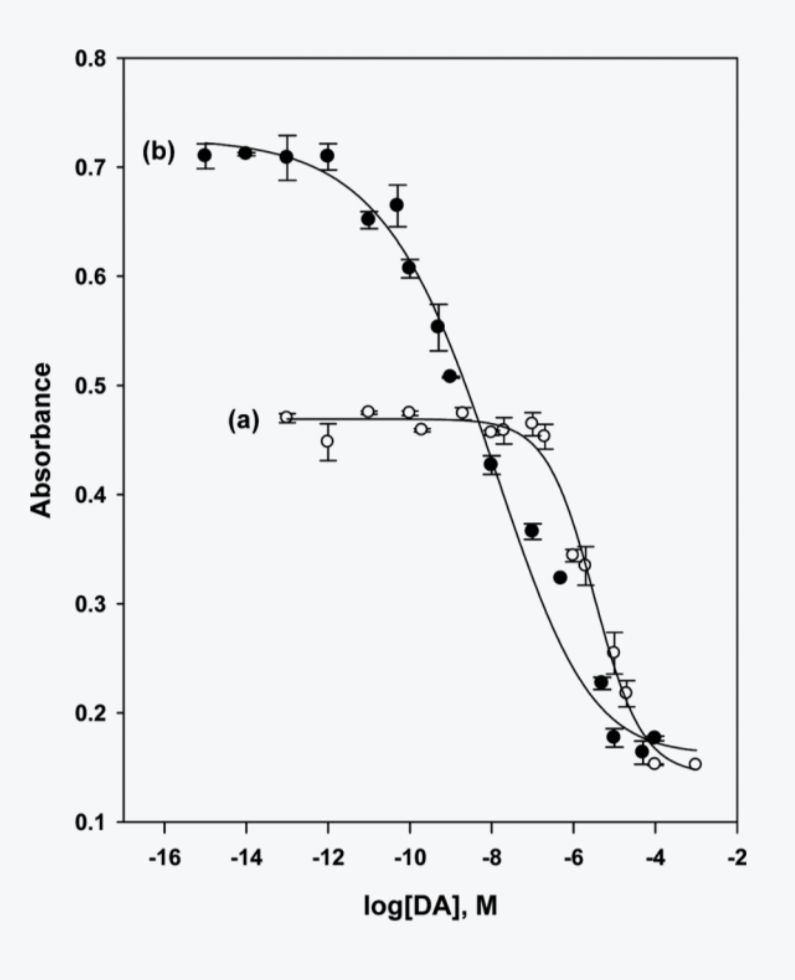
As noted earlier, RNA’s structural flexibility allows it to adopt highly compact shapes that enable strong binding to challenging targets, a functionality that is far more limited with DNA aptamers. However, this flexibility means that a single RNA sequence can fold into many shapes, not all of which will be active. For example, under normal conditions, only about 25-58% of molecules in a common theophylline RNA aptamer adopt the correct binding conformation, whereas the analogous DNA aptamer exists predominantly in one active fold (5). As a result, although both RNA and DNA are specific with their target, DNA’s tendency toward fewer, more stable shapes often leads to more consistent activity and improved batch‑to‑batch reproducibility.
Application Landscape
DNA and RNA aptamers each offer distinct advantages that determine their suitability for different applications. DNA aptamers are highly stable and robust, making them well-suited for therapeutic, diagnostic and biosensing applications. They are widely used in electrochemical sensors, ELONA assays (“aptamer ELISA”), and portable detection devices for toxins, hormones, and disease biomarkers in complex samples such as blood, saliva, and environmental water sources (3). Their inherent resistance to degradation enables reliable performance in harsh conditions, such as high temperature or pH (6). Additionally, guanine-rich DNA sequences can form G-quadruplex structures (see Figure I), which provide exceptional stability and are increasingly utilised in drug delivery and molecular imaging, particularly in oncology, where they can guide therapeutic agents with precision (7).
Although RNA aptamers are inherently less stable than DNA, their exceptional structural versatility allows them to fold into highly intricate three-dimensional conformations. This ability to form complex, target-specific structures makes RNA aptamers particularly effective for engaging challenging targets such as disease-associated proteins with irregular or dynamic binding surfaces, as well as for intracellular applications, including modulation of the tumour microenvironment (8). RNA aptamers also play a key role in engineered riboswitch systems for gene regulation (a molecular switch that regulates gene expression by acting on the 5′ untranslated region (5′ UTR) of the mRNA) and in fluorogenic “light-up” aptamers such as Spinach and Broccoli, which enable real-time visualisation of RNA dynamics within living cells, capabilities that DNA cannot replicate (9, 10, 11).
To bridge these strengths, researchers are developing chemically modified RNA aptamers with enhanced stability and designing DNA–RNA chimeras that combine durability with structural complexity (12). This convergence is expanding the functional landscape of aptamers, paving the way for innovative applications across diagnostics, therapeutics, and molecular biology.
Conclusion
Selecting between DNA and RNA aptamers is not a question of superiority but of suitability for the intended application. DNA aptamers offer inherent stability, cost-effectiveness, and ease of synthesis, making them the preferred choice for diagnostics, sensors, and extracellular therapeutic strategies. In contrast, RNA aptamers provide unique advantages when structural complexity or intracellular functionality is essential, provided that appropriate chemical modifications are applied to address their native instability.
Advances in nucleic acid chemistry and selection technologies are blurring the lines between DNA and RNA aptamers, enabling chemical modifications that allow DNA to adopt RNA-like compact structures while enhancing RNA aptamers with DNA-like stability. Ultimately, the choice should be guided by application-specific requirements, including target environment, desired half-life, structural demands, and regulatory considerations. A systematic evaluation of these factors ensures that the selected scaffold delivers optimal performance, enabling aptamers to reach their full potential across diagnostics, therapeutics, and molecular research.
At PentaBind, we are the pioneers of AI-driven DNA and RNA aptamer design. Our technology combines the power of the largest aptamer dataset of its kind with advanced machine learning models and proprietary wet-lab workflows. This fusion of computational intelligence and experimental precision allows us to design, optimise, and validate aptamers faster and with higher accuracy than traditional approaches.
Whether you’re developing cutting-edge diagnostics, targeted therapeutics, or innovative molecular tools, our platform delivers aptamers that meet your performance goals with unmatched reliability. And with a decade experience in taking aptamers to market, we are your trusted partner for commercial aptamer projects.
Book a call with our team today to explore how PentaBind can accelerate your project and give you a competitive advantage.
References
(1) Šponer, J. et al. (2018) ‘RNA structural dynamics as captured by molecular simulations: A comprehensive overview’, Chemical Reviews, 118(8), pp. 4177–4338.
(2) White, R.R., Sullenger, B.A. and Rusconi, C.P. (2000) ‘Developing aptamers into therapeutics’, Journal of Clinical Investigation, 106(8), pp. 929–934.
(3) Viglasky, V. and Hianik, T. (2013) ‘Potential uses of G-quadruplex-forming aptamers’, General physiology and biophysics, 32(02), pp. 149–172.
(4) Kim, E. and Paeng, I.R. (2013) ‘Advantageous sensitivity in the DNA homolog of the RNA dopamine aptamer’, Journal of Immunoassay and Immunochemistry, 35(1), pp. 83–100.
(5) Warfield, B.M. and Anderson, P.C. (2017) ‘Molecular simulations and Markov state modeling reveal the structural diversity and dynamics of a theophylline-binding RNA aptamer in its unbound state’, PLOS ONE, 12(4).
(6) Zhou, J. and Rossi, J. (2016b) ‘Aptamers as targeted therapeutics: Current potential and challenges’, Nature Reviews Drug Discovery, 16(3), pp. 181–202.
(7) Figueiredo, J., Mergny, J.-L. and Cruz, C. (2024) ‘G-quadruplex ligands in cancer therapy: Progress, challenges, and Clinical Perspectives’, Life Sciences.
(8) Xiang, D. et al. (2015) ‘Nucleic acid aptamer-guided cancer therapeutics and diagnostics: The next generation of cancer medicine’, Theranostics, 5(1), pp. 23–42.
(9) Garst, A.D., Edwards, A.L. and Batey, R.T. (2010) ‘Riboswitches: Structures and mechanisms’, Cold Spring Harbor Perspectives in Biology, 3(6).
(10) Filonov, G.S. et al. (2014) ‘Broccoli: Rapid selection of an RNA mimic of green fluorescent protein by fluorescence-based selection and directed evolution’, Journal of the American Chemical Society, 136(46), pp. 16299–16308.
(11) Pothoulakis, G. et al. (2013) ‘The spinach RNA aptamer as a characterization tool for synthetic biology’, ACS Synthetic Biology, 3(3), pp. 182–187.
(12) Panigaj, M. et al. (2019) ‘Aptamers as modular components of therapeutic nucleic acid nanotechnology’, ACS Nano, 13(11), pp. 12301–12321.